Showing posts with label CMS50E pulseox. Show all posts

Wednesday, February 15, 2012

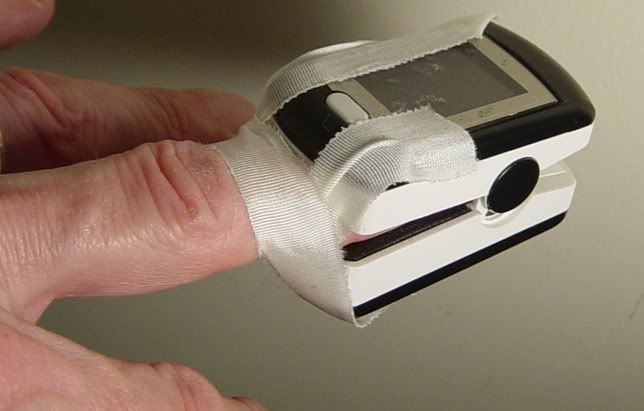
Attaching the CMS50E PulseOx for Overnight

I use the Contec CMS50E pulse oximeter and put it into record mode and sleep with it on my finger.  OK, so how do I not have it fall off at night?  I tape it on...

I tear two 0.25" wide strips of medical tape about 4" long. I put on the CMS50E then drape the center of the tape over my finger and attach the tape ends on the underside of the pulse ox, then repeat such that the 2nd piece of tape comes up from under wrapping my finger and the ends are on the top of the pulse ox (or vise-versa, as shown). I can use the tape tension to control how tight the pulse ox is clamping on my finger. The two pieces of tape last a couple weeks before needing to tear off a couple more strips. I have great control over tension of the clamping-on of the device, from crushing to flippy-floppy and everywhere between. Try it. It won't come off.


Saturday, January 28, 2012

An Unusual Night

Last night is noteworthy because it was unusual.  Below you see an annotated chart showing the ResMed data (top chart), Pulse-Ox and Zeo brain waves (middle chart) and at the very bottom, the Zeo 5 minute sleep stages from the Zeo web site.  The "night" was unusual because I had some sort of metabolical "issue" at the beginning, then fell asleep for a while without my ResMed nor pulse-oximeter on, then woke up and put them on and went back to sleep.

The numbers with circles are some interesting points:

 (Click for a bigger image)

1. Before all this I think I had a "hypoglycemic" (diabetic type) episode.  I'm not diabetic, but I felt very strange, broke out in a sweat, felt "minty sweaty" all over my body and very light headed, almost passing out (buzzzz).  It was like I had food poisoning and was going to "pay the price".  I also felt hypotensive so I checked my blood pressure but it was normal.  I became very thirsty and craved sugar.  I drank a large glass of water and a bunch of Oreos and started feeling better.  Strange.

2. After all those Oreo cookies, I felt sleepy and laid down.  I fell asleep for about 3 hours without my xPAP.  I think I was probably snoring pretty good.  Oops. Not proper therapy.

3. I woke up at 12:30 AM, did this-n-that for about 45 minutes, then put on the pulse-oximeter and went to sleep again with the ResMed.

4. About 2 hours into that sleep, I can see in my data I had a cluster of apneas and some distress (breathing with some "excitement").  During this time I de-sated to 86% due to not only long duration apneas, but many in succession.

5. I notice in my Zeo brain wave data that the deeper sleep "fish eyes" that form in my brain waves are more pronounced during my untreated "nap" than during my "sleep".  I think it was because I had gotten that deeper rest first, then later I didn't need it so much.  Just a theory, because every night I see those deep sleep "fish eyes" progressively get smaller during the night, so this fits here as well.

6.  You can see from the brainwaves that I was getting sleepy, that on-set was coming even though I was still awake.  The waves were converging.

Just an odd night and it is interesting to me to see what was going on.

Friday, January 27, 2012

Now have Zeo, CMS and ResMed Data Together

OK, we finally have a successful mechanism to import, store, extract and synchronize Zeo brainwaves and sleep stage classifications (gathered real-time), CMS50E heart rate and spO2 (gathered post-sleep) and now data from the ResMed S9 AutosSet (post-sleep also).  The CMS50E data we, in theory, could capture in real-time as well, but we will leave it a post-sleep import for now.  If we need to do something with it in real-time we'll do it.

Here's an example chart of such synchronized data:


So, in our database we have:

CMS50E:
spO2, Pulse

Zeo (real time)
Delta, Theta, Alpha, Beta 1, Beta 2, Beta 3, Gamma, Sleep Stage,

ResMed:
Mask Pres, Therapy Pres, Exp Press, Leak, RR, Vt, MV, Snore Index, FFL Index, Flow_HD, Mask Pres_HD

Next, I'll come up with a way to summarize various measures from these time series on a nightly basis, as I think I want to analyze and optimize on a nightly basis... what happened the day(s) before, what happened during the night and how will I feel the next day.

As a part of this, I will also create my own "Sleep Stage" metrics, probably not following the medical standards, but something more meaningful.  Sleep is not "binary mutually exclusive states" (Wake, Light, Deep, REM) but as can be seen in the brainwaves, a continuous shifting between various forms of sleep.

Monday, January 23, 2012

Caught a CMS 50E / spO2 Revew Problem

In downloading the data from the CMS 50E pulse-oximeter, which was in record mode overnight, into the spO2 Review software we found a problem...  The spO2 Review software provided by Contec writes *.SPOR files to disk that we import into our software.  When we went to import the SPOR file this AM into our software and queried the data in our software there was none for last night... what?  Our software said the there wasn't any and the last available date for data was tomorrow.  Eh?  So we threw our software into debug mode and watched it read the SPOR file... The data in the SPOR file was reported as starting tonight, not last night.  There must be a bug in either the CMS50E itself or in the spO2 Review software.  We've worked around it now.  Other persons that may be writing a data interface to these files probably should be aware if they don't already know.  It's not a problem in the spO2 Review software because they don't seem to report the date when viewing the pulse and oximetry.

And yes, the CMS 50E / spO2 Review software has a bit of a Y2K issue which we work around also... The year in the file is 2 digits, such as 12 for 2012. Not really a bother, but we have accommodated for that as well because Microsoft .NET does not like two digit years when parsing dates.

Friday, January 20, 2012

Equipment

I have a variety of equipment that I am using and I might get more, we'll see.  Here's my list:
  • ResMed S9 AutoSet. This is a medical device that is a fully data capable auto positive airway pressure (APAP) sleep apnea treatment system.  It applies a varying air pressure to my face using a sealed mask, which forces my airway open if it needs to as I sleep.  This device gives me information such as:
    * Event Flags: What kind of breathing event I have, when it occurred and for how long
    * Air Flow Rate as I breath in and out
    * Mask Pressure which varies as the machine tries to eliminate events
    * Tidal Volume which is the amount of air I'm breathing in and out
    * Minute Ventilation, similar to Tidal Volume, but the amount per minute.
    * AHI, an index that reports the events/hour.
    * Leak rate (how much the mask is leaking)
    * Snore Index (how much I'm snoring)
    * Respiration Rate (breaths / minute)

    Data from the ResMed S9 AutoSet is from an SD card, which you pop out of the ResMed S9 AutoSet and put into a card reader in your PC.  Presently, until I can get this data into our software, I use SleepyHead to view trend charts with it.

    Note: I highlight the word AutoSet because so there is no confusion with other ResMed "Auto" machines that are not necessarily data capable.
    .

  • CMS 50 E Pulse Oximeter.  This is a that device clips on my finger and as I sleep it records my heart rate and blood oxygen levels (spO2).  It is not a medical device, and is therefore not very accurate, but good enough to know what is going on.  The pulse rate is reasonably accurate.  The spO2 is within 2% when above a 70% spO2 reading.

    Data from the CMS 50 is available through a provided USB/Serial cable and the data can stream from the device in real-time, or the device can store it for up to 24 hours each session and then it can be transferred to your PC using the provided USB/Serial cable.  It comes with two software applications; real-time and session review (SpO2 Review).  I use the latter to fetch sessions off of the device and the SpO2 Review application dumps the data to disk, which then I import into our software.

    Available from Amazon (?) or the PulseOxStore.
    Software and the device driver, if you need them, may be found here at the PulseOxStore.
    .

  • Zeo Bedside Sleep Management System. (psst... you can get it cheaper on Amazon).  A rather cool non-medical device that has a headband that you wear and it measures electrical activity through the skin on your forehead.  This activity is in part facial movements but principally your brain's frontal lobe electrical activity.  The Zeo Bedside gathers this data in a fancy alarm-clock and generates various information about your sleep, most notably crude, but generally correct, estimates of what your sleep stages (Wake, REM, Light and Deep) were during the night every 5 minutes. It is computing this every 30 seconds based on frequencies calculated every second, based on a brain electrical activity measured 128 times per second.

    Data from the Zeo is available either through

    * An SD card, on which there is a night's sleep session, which then can be transferred to your PC, uploaded to their web site and used in a user friendly sleep coaching system with lots of interesting charts, statistics and such.  You can also download data, summarized by night, to your PC again in a CSV file, one column of which has 30 second sleep stage estimates.

    * A serial port in real time.  The Zeo does not come with a USB/Serial cable however, you must make one. :(  I did and I'll tell you how.  And when you do make one, there is an application called ZeoScope that enables you to see your brainwave and the amplitude (I think) of Alpha, Beta (1, 2, 3), Delta, Gamma, Theta frequencies the impedance of the band on your skin and also the sleep stages the Zeo is estimating.

    Presently, I use both the SD card / web site to get Sleep Stage charts and a serial cable to collect the real-time stream into our software.

  •  X16-1C Accelerometer by Gulf Coast Data Concepts.  Tells me the orientation of my body and head while I sleep, such as on my belly, head to left or right, or on my back, head left or right.  This device confirmed without a doubt my positional sleep apnea.

    This device is not only an accelerometer, but a USB thumb drive that contains the data it creates in text CSV file format.  Spiffy !  Easy.